
Choosing the China best Nitrogen Generator is not simply a price comparison. The right system must match your gas demand, purity target, operating pressure, and working environment. A small laboratory may need stable 99.999% purity, while laser cutting equipment may require continuous flow and dependable pressure. These are different purchasing decisions.
Compressed-gas specialist Liu Wei explains, “The best nitrogen generator is not the largest; it is the one matched to purity, flow, and duty cycle.” This practical observation deserves attention. A PSA Nitrogen Generator can deliver high purity for demanding industrial applications. A membrane model may offer simpler operation and lower maintenance for moderate requirements. Both can be effective. Neither is automatically superior.
Look beyond the polished product brochure. Check the compressor brand, molecular sieve quality, oxygen analyzer, air receiver size, and control system. Ask for tested flow rates at your required purity, not attractive figures measured under ideal conditions. Visit the manufacturer if possible. Observe the assembly area, wiring, cooling layout, and spare-parts storage. Small details often reveal long-term reliability.
Service matters too. Can the supplier respond within hours, or only after several emails? Are manuals clear? Are replacement valves available locally? Energy consumption should be calculated over several years, not judged from the purchase invoice. I may favor a PSA unit for demanding factories, but that preference is not universal. Your production schedule, budget, and maintenance skills may point elsewhere. The best choice becomes clearer when real operating data replaces sales language. There is no perfect machine. There is only a better-matched one.
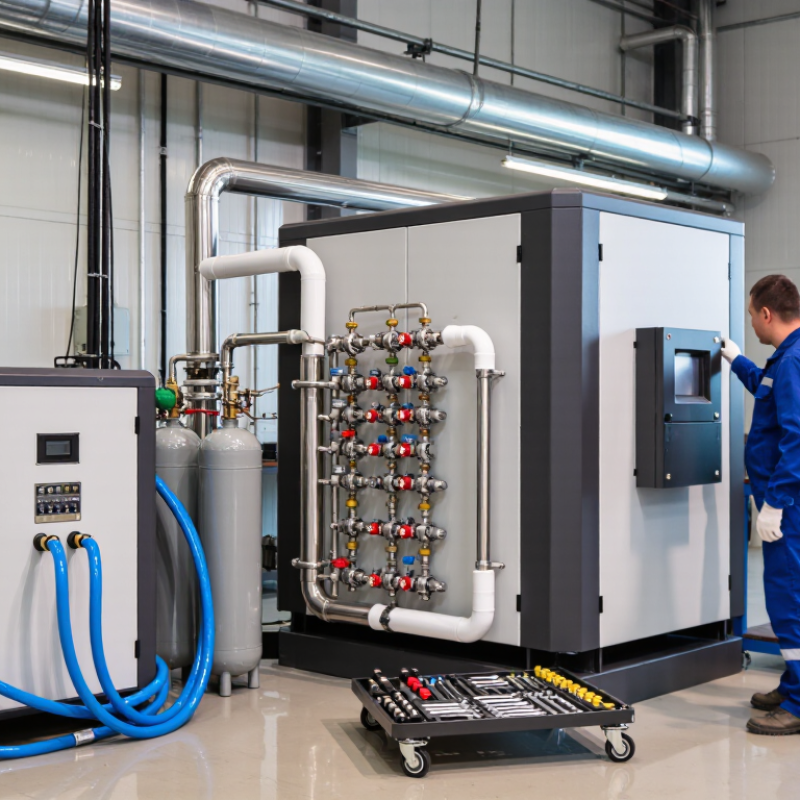
Nitrogen generators in China commonly use PSA, membrane separation, or cryogenic separation. PSA systems compress clean air into molecular sieve beds. The sieve captures oxygen, moisture, and other gases, while nitrogen passes through. The beds switch automatically, creating a continuous supply. PSA suits food packaging, laser cutting, heat treatment, and electronics production. It can deliver high purity, but it needs stable air pressure and regular filter replacement.
Membrane generators work differently. Hollow fibers allow oxygen and water vapor to pass faster than nitrogen. The remaining gas becomes nitrogen-rich. These systems are compact, quiet, and useful for tire filling, pipelines, and fire prevention systems. Their purity is usually lower than PSA output. Cryogenic units cool air until its components separate by boiling point. They support very large nitrogen demand, but require greater space, investment, and technical control.
A practical selection starts with actual consumption, not a catalogue number. Measure peak flow during packaging or cutting cycles. Check required purity, outlet pressure, dew point, and available compressor capacity. Poorly dried air can damage molecular sieves within months. It is an easy detail to miss. Ask for performance data under your working conditions, not ideal laboratory figures. Service response, spare parts, noise, and energy use also affect long-term cost. The choice is rarely perfect. A smaller generator may save energy, yet fail during production peaks. A larger unit may provide comfort, but waste power every hour.
Choosing the best nitrogen generator from China starts with supplier comparison, not catalog price. Ask for measured purity, flow, outlet pressure, and power consumption under your real operating conditions. A U.S. Department of Energy compressed-air assessment report notes that compressed air can consume 10–15% of industrial electricity, and sometimes much more. A small efficiency gap can therefore become a large annual cost.
Request test records, not broad promises. The supplier should state oxygen outlet limits, recovery time, dew point, noise, and performance at changing demand. Confirm whether purity testing follows ISO 8573-1 methods and whether electrical components carry suitable certification for your destination market. Inspect production evidence: membrane or PSA vessel materials, valve-cycle testing, leak checks, and final inspection photographs. These details reveal experience.
Service quality often separates a dependable supplier from a cheap one. Compare spare-parts lists, remote commissioning, response times, warranty exclusions, and technician training. The International Energy Agency reported that industry used about 37% of global final energy in 2022, making efficiency claims worth challenging. Ask for a 12-month energy model using your electricity tariff and duty cycle. Some calculations look impressive because they ignore standby hours. That is a weakness worth questioning. Also, leave room for doubt: laboratory purity may not match performance beside a hot compressor room. Request a witnessed factory acceptance test and at least one comparable installation reference.
Choosing China’s best nitrogen generator starts with your process, not the catalog capacity. A 100 Nm³/h unit may fail when demand peaks during shift changes. Record normal flow, peak flow, pressure, purity, and daily operating hours. Peak demand matters. Use a calibrated flowmeter for one complete production cycle. The U.S. Department of Energy’s 2016 sourcebook states that compressed-air systems can consume about 10% of industrial electricity. It also reports that leaks may waste 20–30% of compressor output.
Size the generator for peak nitrogen demand, then add a controlled margin, commonly 10–20% after testing. Include pipe losses, start-up purging, analyzer sampling, and future production changes. A packaging line using 55 Nm³/h normally and 72 Nm³/h during sealing should not use a 55 Nm³/h generator. A practical target may be 82–86 Nm³/h, depending on purity and inlet conditions. Check flow at the required purity, not a lower test specification. ISO 8573-1 supports air-quality classification, while EIGA guidance emphasizes purity verification and continuous monitoring.
Pressure also changes capacity. Hot inlet air, blocked filters, and wet membranes can reduce output. The Compressed Air and Gas Institute recommends evaluating performance under actual operating conditions, not only nameplate figures. I would avoid adding a large safety margin blindly. Oversizing increases cost and may cause inefficient cycling. Undersizing creates unstable pressure and emergency cylinder purchases. Compare measured demand with the generator curve, storage volume, compressor duty, and alarm settings. Real factories change faster than spreadsheets.
How to Match Generator Capacity With Your Application
The chart shows representative industrial design points in Nm³/h. Confirm the final capacity with measured peak consumption and required nitrogen purity.
Choosing the best nitrogen generator in China starts with your application, not the lowest quotation. Food packaging may require moderate purity, while laboratories or laser cutting often demand tighter specifications. Confirm the required nitrogen purity with an independent test method. A displayed reading is useful, but it is not absolute proof.
Pressure also affects your decision. Check the generator’s outlet pressure under real operating flow, not only its maximum rating. A unit producing 99.99% purity may consume more compressed air and electricity than expected. Ask for energy data at your working pressure and flow rate. Small differences can become expensive during continuous operation. I would also compare recovery time after demand changes. This detail is often overlooked.
Tips: Request a complete maintenance schedule before purchasing. Check filter replacement intervals, sensor calibration needs, valve access, and spare-part availability. Keep the operating area clean and dry. Moisture can shorten filter life. A clear service manual matters as much as the machine itself. Do not accept vague promises about efficiency or purity. Ask for test conditions, including temperature, inlet pressure, and flow. One assumption may fail. Plan for it. Check whether your staff can perform routine inspections safely, because complicated maintenance may create avoidable downtime.
Choosing the best nitrogen generator in China starts with your process, not a product label. Food packaging, laser cutting, electronics, and heat treatment require different purity, flow, and pressure. Record daily consumption, peak demand, operating hours, and nitrogen purity. These figures prevent costly oversizing. An onsite generator can reduce cylinder handling, but it still needs clean compressed air, ventilation, and trained maintenance.
Compare the complete cost, not only the purchase price. Include the compressor, dryers, filters, storage tank, electricity, replacement parts, installation, and service. For a small workshop, a compact membrane system may control initial spending. PSA technology often suits high-purity, steady industrial demand. Ask for measured energy use at your actual flow rate. Payback estimates are useful. They are not promises. A previous planning mistake in many facilities is trusting ideal laboratory data instead of checking real production peaks.
Industry conditions should guide the final specification. Laser cutting needs stable flow during long shifts. Electronics production may require very high purity and reliable pressure control. Food applications demand clean, documented gas pathways. Confirm testing records, safety features, maintenance access, and available technical support before ordering from China. One overlooked detail matters: noise, heat, and floor space can disrupt a crowded workshop. Pilot testing helps, although a short trial may not reveal seasonal temperature changes or filter replacement costs. Ask for operating data from comparable applications, then question any figure that lacks test conditions.
| Generator Type | Typical Nitrogen Purity | Typical Flow Range | Typical Outlet Pressure | Main Operating Cost | Best Applications | Relative Budget | Recommended Choice |
|---|---|---|---|---|---|---|---|
| Membrane Nitrogen Generator | 95%–99.5% | Approximately 1–1,000 Nm³/h, depending on design | Typically 5–30 bar(g) | Compressed air and filter replacement | Fire prevention, food packaging, blanketing, tire inflation, and general industrial use | Low to medium | Choose this option when moderate purity, simple operation, low maintenance, and fast installation are priorities. |
| PSA Nitrogen Generator | 95%–99.999%+ | Approximately 1–5,000 Nm³/h, depending on purity and system size | Typically 4–30 bar(g) | Compressed air, electricity, adsorbent maintenance, and filtration | Laser cutting, electronics, heat treatment, pharmaceuticals, laboratories, and high-purity packaging | Medium | Choose PSA when purity above 99.5%, stable supply, or continuous industrial production is required. |
| Cryogenic Nitrogen Plant | Typically 99.999% or higher | Usually hundreds to thousands of Nm³/h | Product pressure varies by plant configuration | High electrical load, refrigeration, compression, and plant operation | Large gas-production facilities, bulk liquid nitrogen, and very high-volume industrial demand | Very high | Choose cryogenic production only when demand is very large and continuous enough to justify complex infrastructure. |
| Small Packaged PSA Unit | 99%–99.999% | Approximately 0.5–100 Nm³/h | Typically 5–10 bar(g) | Compressed air and electricity | Small workshops, laboratories, laser cutting, food processing, and pilot production | Low to medium | Choose this option when demand is limited but purity control and on-site production are important. |
| High-Capacity PSA System | 99.5%–99.999%+ | Approximately 100–5,000 Nm³/h | Typically 6–30 bar(g) | Compressed air, electricity, cooling, and scheduled service | Steel, metal fabrication, chemical processing, large food plants, and multiple production lines | Medium to high | Choose this option when a factory needs reliable 24/7 nitrogen and lower long-term gas-delivery dependence. |
| Containerized or Skid-Mounted System | Usually 95%–99.999%, depending on membrane or PSA technology | Approximately 10–2,000 Nm³/h | Typically 6–30 bar(g) | Compressed air, electricity, cooling, and environmental protection | Remote sites, oil and gas facilities, construction projects, mining, and limited building space | Medium to high | Choose this format when mobility, outdoor installation, modular expansion, or rapid deployment is required. |
| High-Purity PSA with Purification Stage | Up to 99.9999% in suitable configurations | Approximately 1–500 Nm³/h | Typically 5–20 bar(g) | Compressed air, electricity, purification media, and analytical monitoring | Electronics, analytical laboratories, specialty chemicals, inerting, and sensitive manufacturing processes | High | Choose this option when trace oxygen, moisture, or hydrocarbon limits are more important than the lowest purchase price. |
