What is a Regulated Power Supply and How Does it Work?
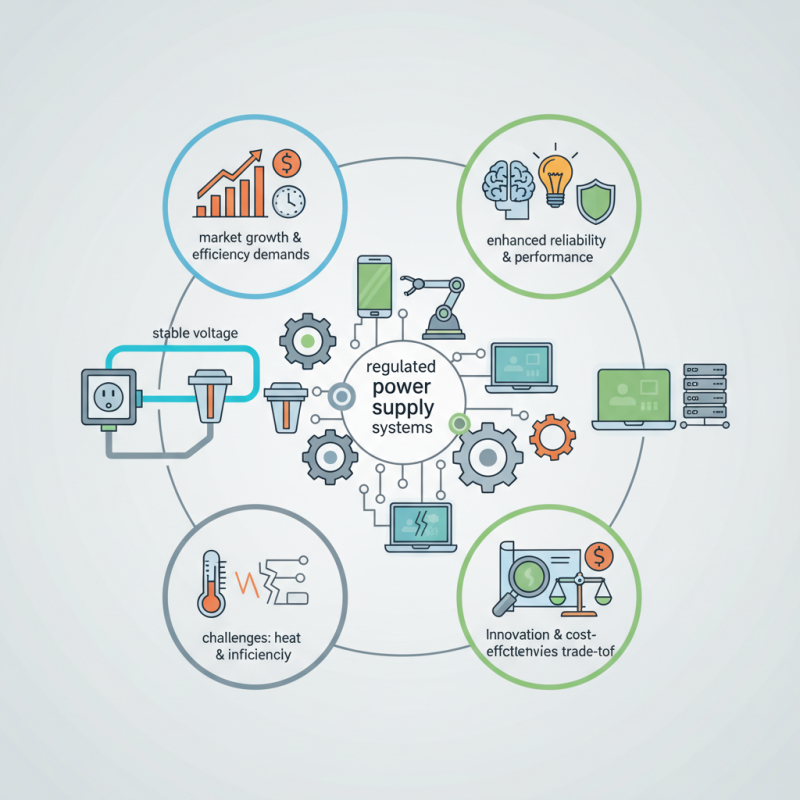
A Regulated Power Supply (RPS) is essential in numerous applications, from consumer electronics to complex industrial systems. According to a report by Market Research Future, the global regulated power supply market is projected to grow at a CAGR of 5.2% through 2026, driven by advancements in technology and increasing energy efficiency demands. This growth highlights the critical role that regulated power supplies play in ensuring stable performance in various devices.
Industry expert Dr. Emily Carter emphasizes, "A regulated power supply not only enhances reliability but also improves the performance of electronic components." Her insights reflect the fundamental importance of RPS in maintaining consistent voltage levels. Despite advancements, the technology is not without challenges. Issues such as heat generation and inefficient designs can lead to performance losses.
As industry standards evolve, the need for innovative solutions in regulated power supply design becomes evident. Engineers must balance efficiency and cost effectiveness, often leading to a complex trade-off. This ongoing challenge calls for continuous reflection and improvement in power supply technology.
What is a Regulated Power Supply: Definition and Purpose
A regulated power supply is essential in many electronic devices. Its main purpose is to provide a stable output voltage. This stability ensures that sensitive components receive the proper power. Without this regulation, devices might malfunction due to voltage fluctuations.
Understanding how this device works is crucial. A regulated power supply typically uses feedback mechanisms. These mechanisms adjust the output based on changes in load or input voltage. This automatic adjustment helps maintain consistent performance in various conditions.
Tips: Always check the specifications before using a power supply. Not all supplies are ideal for every device. If in doubt, consult with professionals. Additionally, ensure proper ventilation to avoid overheating. Overheating can lead to failure or damage. Using a regulated power supply improves reliability, making your devices last longer. Remember that even small details can greatly impact performance.
Key Components of Regulated Power Supplies: An Overview
Regulated power supplies are essential in various industries, ensuring devices receive stable voltage and current. Their key components include transformers, rectifiers, and voltage regulators. Each plays a crucial role. For instance, transformers adjust the voltage levels. According to industry reports, the transformer market is projected to grow at a CAGR of 6.5% from 2022 to 2028. This growth indicates a rising demand for efficient voltage regulation.
Rectifiers convert AC to DC, making them vital in powering electronic devices. Studies show that over 70% of modern electronics require DC power. Failure in rectifier design can lead to inefficiencies. Voltage regulators maintain output stability, even with input fluctuations. Many engineers recognize this as a common challenge, especially in power-sensitive applications. Thus, achieving the perfect balance between performance and cost remains a concern.
In practice, selecting components can be complex. Designers often face trade-offs regarding efficiency, heat dissipation, and reliability. For example, higher efficiency often leads to increased costs. Industry data suggests that around 40% of power supplies do not meet the necessary efficiency standards. Therefore, continual improvement and innovation are essential for overcoming these challenges and enhancing power supply performance.
Types of Regulated Power Supplies and Their Applications
Regulated power supplies come in various types, each serving specific applications. Linear power supplies are simple and provide low noise output. They are often used in laboratory settings. These supplies can be bulky and inefficient, primarily when handling higher loads. Switching power supplies, in contrast, are more compact and energy-efficient. They convert electrical energy with high speed, making them great for portable devices and computers.
Another common type is the programmable power supply. It allows precise control over voltage and current. Engineers often use them for testing and development. These supplies require careful handling, as improper settings can lead to equipment damage. Lastly, uninterruptible power supplies (UPS) provide backup during outages. They ensure critical systems stay operational, but can be expensive to maintain. Choosing the right type demands a clear understanding of the application's needs.
Types of Regulated Power Supplies and Their Applications
How Regulation Mechanisms Maintain Voltage Stability
Regulated power supplies are essential in various applications, especially in electronics. They maintain a consistent voltage level despite fluctuations in input power. This ensures devices operate correctly. An effective regulated power supply can improve device reliability and lifespan.
Voltage regulation mechanisms are crucial. They use feedback loops to monitor the output voltage. If the output varies, adjustments are made immediately. This keeps the voltage stable. A 2019 report by the International Electrotechnical Commission states that stable voltage can improve energy efficiency by up to 20%.
However, challenges remain. Some regulation mechanisms may introduce noise into the power supply. This can affect sensitive electronics. Engineers need to balance stability and noise levels. Continuous monitoring and adjustments are needed. This allows for optimal performance under varying conditions. Understanding these dynamics is essential for advancements in power supply technology.
What is a Regulated Power Supply and How Does it Work? - How Regulation Mechanisms Maintain Voltage Stability
| Feature | Description | Importance |
| Input Voltage | The voltage supplied to the power supply unit from the AC mains. | Determines the suitable range for operation and efficiency. |
| Output Voltage | The stabilized voltage delivered to connected devices. | Essential for the proper functioning of electronic devices. |
| Load Regulation | The ability of the power supply to maintain output voltage despite changes in load current. | Ensures consistent performance under varying conditions. |
| Line Regulation | The ability of the power supply to maintain its output voltage despite variations in input voltage. | Crucial for protecting devices from voltage fluctuations. |
| Ripple Voltage | The AC voltage component superimposed on the DC output voltage. | Low ripple is vital for the stable operation of sensitive electronics. |
| Protection Features | Includes overload, short-circuit, and thermal protection mechanisms. | Enhances safety and longevity of the power supply and connected devices. |
Understanding Load Regulation and Its Impact on Performance
Load regulation is a crucial aspect of a regulated power supply. It refers to the power supply's ability to maintain a stable output voltage despite changes in the load. According to a report by T&M Solutions, poor load regulation can lead to significant performance issues, impacting sensitive electronic devices. Variations in load can cause voltage fluctuations that might damage components or disrupt operations.
Typically, load regulation is expressed in terms of percentage. A regulation of 1% indicates that the output will not deviate by more than 1% under varying loads. Devices requiring stringent regulation, like precision instruments, often need supplies with load regulation better than 0.1%. In a study published by IEEE, it was noted that inadequate load regulation could reduce the reliability of systems in critical applications by up to 30%.
Consider an example in a laboratory setting where precise measurements are vital. If the load changes drastically, and the voltage output rises unexpectedly, the data collected may be inaccurate. Engineers must pay close attention to load regulation when designing circuits. Testing under various loads is not just advisable; it’s essential. With increasing dependence on electronics, understanding load regulation is more important than ever.