10 Tips for Choosing the Right End Dump Truck
Choosing the right End Dump Truck begins with the worksite, not the showroom.
The FHWA Freight Analysis Framework projects continued growth in U.S. freight movement through 2050. That growth increases pressure on hauling productivity, operating costs, and equipment reliability. However, national forecasts cannot predict every quarry, road project, or construction cycle. Local conditions still matter more.
A useful evaluation starts with payload, body volume, axle configuration, and legal weight limits. The truck must carry material efficiently without creating unstable handling or excessive tire wear. A 25-ton payload may sound attractive, yet poor ground conditions can reduce practical output. Mud, steep ramps, tight turns, and frequent stops expose weaknesses quickly.
Fuel use deserves close attention. The U.S. Department of Energy identifies vehicle weight, speed, idling, and maintenance as major influences on fuel consumption. A lighter chassis may save fuel, but it can reduce durability under severe-duty applications. That trade-off is easy to overlook.
Hydraulic cycle time also affects daily production. A slow hoist can create long queues beside the unloading area. Cab visibility, braking performance, suspension design, and operator access deserve equal review. OSHA guidance reinforces the importance of safe operation, inspection, and training around mobile equipment.
Industry experience shows that the cheapest purchase price is rarely the complete cost. Service coverage, parts availability, warranty terms, and resale value can change the decision. A dealer’s promise should be tested against response times and documented maintenance records.
No checklist is perfect. Actual site data may challenge the original choice. These ten tips provide a practical framework for comparing an End Dump Truck with clearer judgment, stronger evidence, and fewer expensive assumptions.
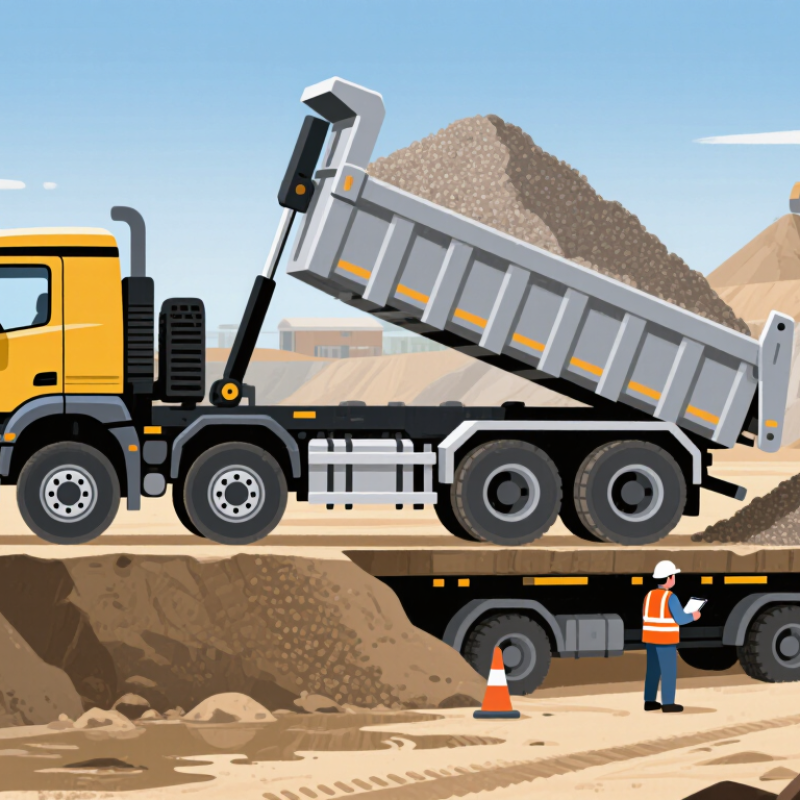
Define Payload, GVWR, and Axle Limits Across 10–40-Ton End Dumps
Choosing an end dump truck starts with the material, not the advertised tonnage. Define payload as the legal, usable load, not the box’s maximum volume. A 10-ton dump may carry 10 tons only under specific body, road, and axle conditions. Moist soil, crushed stone, and demolition debris can produce very different weights. Measure the material. Record typical load weights from certified scale tickets. Then compare those figures with GVWR, the truck’s total permitted loaded weight. GVWR includes chassis, body, fuel, driver, tools, and payload.
Check the front and rear axle limits separately. A load can remain below GVWR yet overload one axle. That error appears when wet material slides forward during braking. For 20- to 40-ton end dumps, axle spacing and suspension capacity deserve close inspection. Ask for rated limits, tire capacity, and the approved configuration in writing. Do not rely on a sales sheet alone. On rough sites, leave practical margin for uneven ground and shifting loads. My field mistake was treating volume as payload; the truck looked half full, but the scale said otherwise.
Match the truck to route length, loading equipment, and dump frequency. A 10-ton unit may suit narrow access roads, while a 40-ton unit needs stronger routes and turning space. Test the tailgate, hoist response, visibility, and control layout before purchase.
Inspect welds and pivot points after a loaded cycle. Small details matter. Review maintenance records, but question gaps instead of assuming perfect care. Have an experienced operator perform a loaded demonstration, because brochures cannot show body balance. Recheck local weight rules before delivery, since permitted axle limits can vary by route and jurisdiction.
Match Body Volume to Material Density Using 18–40 yd³ Capacity Data
Choosing the right end dump truck starts with material density, not body size. Available capacities commonly range from 18 to 40 cubic yards. A large body is not always more productive. Loose mulch may suit a 35–40 yd³ body, while wet sand or crushed stone may require only 18–22 yd³. The same truck can perform very differently across job sites.
Estimate payload with this formula: volume in cubic yards multiplied by material density. For example, 30 yd³ of material at 0.6 tons per cubic yard equals about 18 tons. However, density changes with moisture, grading, and compaction. A 40 yd³ body filled with material weighing 1.2 tons per cubic yard could exceed axle or chassis limits. Never rely on the material’s appearance. Use certified scales and check the truck’s rated payload before hauling.
Field conditions also matter. Narrow access roads, soft ground, and frequent loading cycles may favor a smaller body. It can load more consistently and reduce spillage. Bigger is not always better. I would treat catalog capacity as a starting point, not a guarantee. Recheck real payloads during the first week of work. An 18 yd³ body may outperform a 40 yd³ body when every legal, stable load reaches the destination safely.
10 Tips for Choosing the Right End Dump Truck - Match Body Volume to Material Density Using 18–40 yd³ Capacity Data
Estimated material mass by body volume. Use the figures to compare truck capacity with material density before selecting an end dump configuration.
| Material | Typical Loose Bulk Density
(t/m³) | Estimated Load Mass by Body Capacity (metric tonnes) |
18 yd³
(13.76 m³) | 22 yd³
(16.82 m³) | 26 yd³
(19.88 m³) | 30 yd³
(22.94 m³) | 34 yd³
(26.00 m³) | 40 yd³
(30.58 m³) |
| Topsoil | 1.10–1.40
1.25 used | 17.2 | 21.0 | 24.9 | 28.7 | 32.5 | 38.2 |
| Sand | 1.50–1.80
1.65 used | 22.7 | 27.8 | 32.8 | 37.9 | 42.9 | 50.5 |
| Natural Gravel | 1.50–1.80
1.70 used | 23.4 | 28.6 | 33.8 | 39.0 | 44.2 | 52.0 |
| Crushed Stone | 1.60–1.90
1.75 used | 24.1 | 29.4 | 34.8 | 40.1 | 45.5 | 53.5 |
| Asphalt Millings | 1.00–1.40
1.20 used | 16.5 | 20.2 | 23.9 | 27.5 | 31.2 | 36.7 |
| Demolition Debris | 0.40–0.80
0.60 used | 8.3 | 10.1 | 11.9 | 13.8 | 15.6 | 18.3 |
How to use this table: Estimated load mass is calculated as body volume in cubic metres multiplied by the representative loose bulk density shown in bold. Actual density varies with moisture, grading, compaction, and material composition. The truck’s rated payload, axle limits, bridge formula, tire rating, and local legal weight restrictions always take priority over body volume. One cubic yard equals approximately 0.7646 cubic metres.
Compare Engine Output and Gradeability Within the 350–600 hp Range
10 Tips for Choosing the Right End Dump Truck
Tip 1: Compare usable power, not just peak horsepower. A 350 hp engine may handle moderate loads efficiently on level roads. A 600 hp engine offers stronger reserve power on steep haul routes. However, extra power can increase fuel use when the truck works mostly on flat ground. Check torque curves, transmission ratios, and engine response below peak speed.
Tip 2: Study gradeability with the intended payload. A truck’s climbing ability depends on engine output, gross weight, tire size, axle ratio, and road surface. Ask for gradeability charts at realistic operating weights. A five-percent gravel slope feels different after rain. Test the truck on a familiar route if possible. Numbers alone can mislead.
Tip 3: Match horsepower to working conditions. For short urban hauls, 350–450 hp may provide balanced performance. Long quarry routes, heavy payloads, and sustained climbs may justify 500–600 hp. Do not ignore cooling capacity or retarder performance. Heat builds quickly during repeated descents.
Tip 4: Confirm the rating with independent data. Compare tested fuel consumption, climbing time, and restart performance. Speak with operators who drive similar routes daily. Their comments often reveal details missed in brochures. I would also review maintenance records, because a powerful truck with neglected cooling parts may perform poorly. The spreadsheet is never the whole story.
10 Tips for Choosing the Right End Dump Truck: Engine Output vs. Gradeability
This comparison uses representative heavy-duty end dump truck specifications across the 350–600 hp range. Higher horsepower generally improves climbing performance, especially when the truck is fully loaded, but actual gradeability also depends on payload, transmission ratios, axle configuration, tire size, and operating conditions.
Gradeability is shown as the maximum sustained incline under representative loaded operating conditions. Specifications vary by configuration and test method.
Verify Suspension, Brakes, and Safety Compliance Under FMVSS 121
Choosing an end dump truck requires more than checking payload and body volume. NHTSA’s 2022 Traffic Safety Facts recorded 5,837 large trucks involved in fatal crashes. That figure makes braking verification a practical priority.
FMVSS 121 governs air-brake equipment and performance, including stopping ability, warning signals, and pressure retention. Ask for compliance records, not verbal assurances.
Inspect the suspension before the road test. Look for uneven tire wear, cracked spring components, loose fasteners, and air-bag damage. A truck leaning under load may signal poor leveling or an overloaded axle. Check it cold. Then measure air pressure, compressor recovery time, pushrod travel, and brake adjustment. Measure, do not guess.
CVSA’s 2024 International Roadcheck data again identified brake-system defects among leading out-of-service violations. That pattern deserves attention during procurement.
FMVSS 121 does not cover every suspension defect, so the inspection must go further. Confirm axle alignment and examine the frame around suspension mounts.
During a loaded test, the truck should stop straight without steering correction, harsh pulling, or delayed brake response. Listen for repeated air leaks near chambers and fittings.
A clean inspection sheet is not proof of a healthy truck. In field checks, small leaks can hide behind road noise, and worn components may appear acceptable when unloaded. I would require an independent inspection and documented measurements before signing.
Evaluate Fuel, Tire, Maintenance, and Five-Year Total Ownership Costs
Choosing an end dump truck requires a five-year cost model, not a sticker-price comparison. Record annual loaded miles, idle hours, payload, fuel price, tire changes, and service intervals. ATRI’s 2024 Analysis of the Operational Costs of Trucking reported average costs near $2.26 per mile in 2023, with fuel around $0.64 per mile. End-dump work may differ sharply, especially on short hauls and rough quarry roads.
Fuel deserves careful testing. Compare gallons per loaded mile, not advertised economy. A truck that idles beside a loader can quietly erase expected savings. EPA SmartWay guidance indicates verified low-rolling-resistance tires may reduce fuel use by about 3%, but aggressive off-road tread can wear faster. That trade-off needs real route data. Tire casing life, puncture risk, and replacement labor belong in the spreadsheet.
Maintenance costs are less visible but equally important. Price filters, brakes, suspension parts, hydraulic hoses, inspections, and planned downtime. Keep service records by operating hour, not only mileage. My early estimates were too optimistic because they ignored a lost shift during repairs. ATRI’s cost data is a useful benchmark, not a promise for every fleet. Add a contingency for inflation, unexpected component failures, and lower resale value after severe duty. Five-year ownership cost should include fuel, tires, maintenance, financing, downtime, and disposal value.